
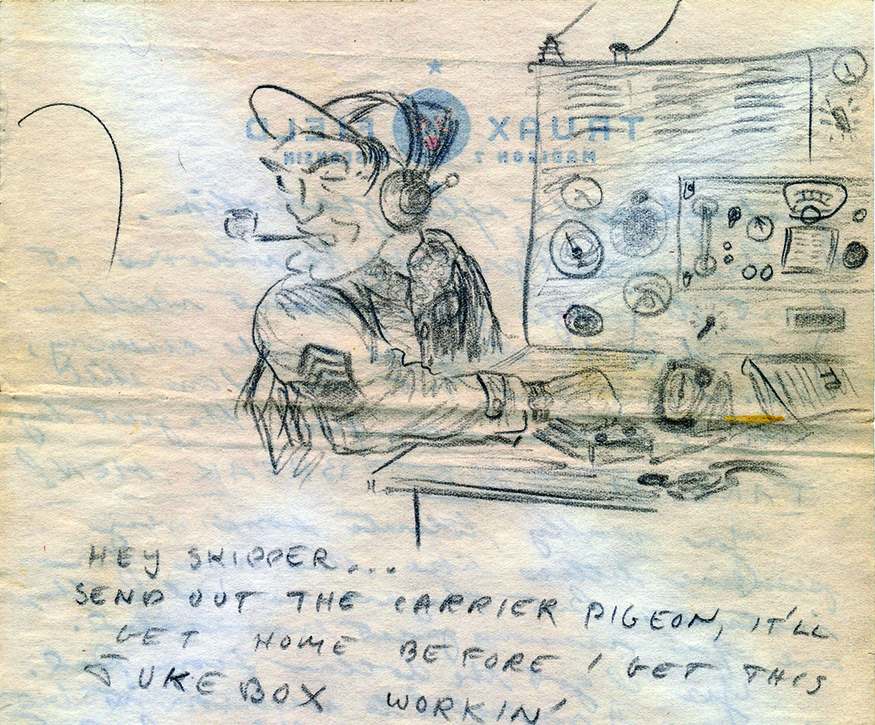
One of the humorous cartoons drawn by young Corporal Ronie F. Dick shows what happens when the radio operator can't get it working: send out carrier pigeons!
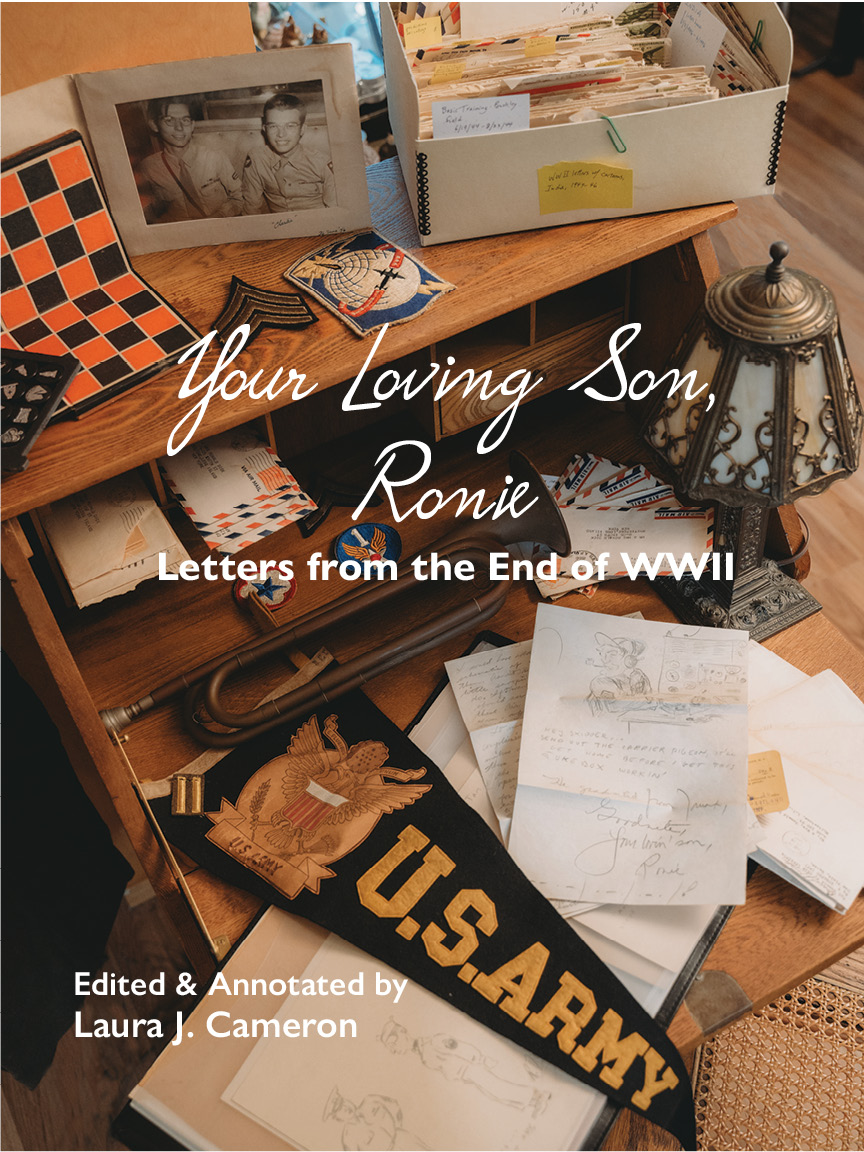
The front cover of new book "Your Loving Son Ronie" shows his souvenirs and mementos.

Laura Cameron, author of "Your Loving Son, Ronie: Letters from the End of WWII," sits at her grandfather's desk with a selection of her father's letters from 1944-1946.
Illustrated, annotated by soldier’s only child, “Your Loving Son, Ronie: Letters from the end of WWII” tells lively stories through 424 long-lost letters
OLYMPIA, WA, UNITED STATES, December 3, 2025 /EINPresswire.com/ -- On December 8, 1941, legislators in a hastily called joint session of Congress heard President Franklin Delano Roosevelt's shocking call for a declaration of war:
"Yesterday, December 7th, 1941 — a date
A 15-year-old lad was listening to that radio broadcast in a quiet Queens, New York, neighborhood. Too young to enlist for military service, Ronie instead rushed to enroll as a civil defense messenger, eager to help protect La Guardia Airport where he’d spent weekend hours plane-spotting. His pink photo I.D. card and a newspaper clipping noting “he first put his bicycle in good working order” still exist. Once Ronie turned 17, he entered a training program that led to a radio mechanic’s certificate, eventually sending him into service in India during the last, consequential years of the Second World War.
We know about the I.D. card — and his subsequent experiences both in the Army and on the Home Front — thanks to a remarkable collection of 424 letters written between the young soldier, Corporal Ronald Francis Dick, and his family and friends.
Lost in dusty shoeboxes for almost 80 years, the letters — many with his original cartoons — have been collected by that soldier's daughter, Laura J. Cameron, in a new book: “Your Loving Son, Ronie: Letters from the End of WWII.”
Her full-color book not only captures the authentic voices of family members during the Second World War, it lets the distinctive voice of Corporal Ronald Francis Dick ring out clearly — by turns exuberant, bored, determined, even philosophical. It brings today’s readers a unique and personal perspective on the war’s effect on soldiers as well as their families.
Eleanor Roosevelt called wives, mothers, sisters and daughters to action
While most Americans know of FDR’s dramatic speech, few may realize Eleanor Roosevelt spoke that very evening about the attack on Pearl Harbor in her regular Sunday night broadcast. Her remarks sought to calm listeners while bolstering morale; she especially addressed the nation’s women. “I have a boy at sea on a destroyer. … You cannot escape anxiety, the clutch of fear at your heart… When we find a way to do anything more we can do in our communities… we must do it.”
Young Ronie’s mother became a war worker herself, and the letters bubble with news from Wheeler Shipyard, where vessels destined for General MacArthur in the Pacific Theater of war slid down the slipways, accompanied by stirring tunes by the Fort Totten band. His sister enrolls in a Red Cross class to become a canteen aide; his friends still in high school learn first aid and study practical, war-time physics and chemistry.
A gift from the past
The book was a labor of love for author Laura Cameron, as she uncovered more and more boxes of her father’s letters and souvenirs. In piecing together his story, and the stories of those left behind, the collection of letters evolved to incorporate five appendices of background information. In the 580-page book, Cameron offers hundreds of quick explanations for military slang; movie, book and radio show references; and the challenges facing those on the Home Front, from gasoline rationing to rabbits marauding the Victory Garden.
With the letters are a collage of Ronie’s cartoons and snapshots, plus postcards and ephemera of the day. Ronald draws himself on a snowy midnight dash to the latrine at Truax Field near Madison, Wisconsin, while colorful postcards mark his first studies at Cornell University in Ithaca, New York. Elaborate comic-style panels show him as a radio operator yelling for the Cap’n to send out carrier pigeons, or wolf-whistling at the WAC he mistakenly believes will be his new assistant — crestfallen when she tells him she’s taking over and he’s going Stateside.
This entertaining and informative book will appeal to everyone who loves first person accounts of daily life in times past, as well as scholars seeking new primary source material from 1944-1946.
For more information or to purchase "Your Loving Son, Ronie: Letters from the End of WWII," please visit www.artforartssakepress.com or contact Laura Cameron at laura@artforartssakepress.com or 360-628-7176.

No comments:
Post a Comment